
Washington Narrowed the Childhood Schedule, and the Insurer Backstop Quietly Stopped Being One
The executive order signed on 10 August cannot move a single coverage dollar, and its own closing section says as much. The instrument that does move money is the insurer commitment everyone has been treating as a backstop since last autumn, and that commitment quietly changed shape in May. The version now published carries no anchor date. It follows the federal schedule wherever the federal schedule goes.
- The order is a declaration, not an instrument. Section 5(c) creates no enforceable right, Section 2(c) qualifies every agency instruction with the phrase to the fullest extent allowable by law, and the federal schedule that does bind coverage has been stayed since 16 March and is under appeal.
- The insurer pledge lost its anchor date ten weeks before the order was signed. The September 2025 commitment covered immunisations recommended as of 1 September 2025, a fixed snapshot. The version published now, updated May 2026, covers all ACIP-recommended immunisations through the end of 2027 with no date attached at all.
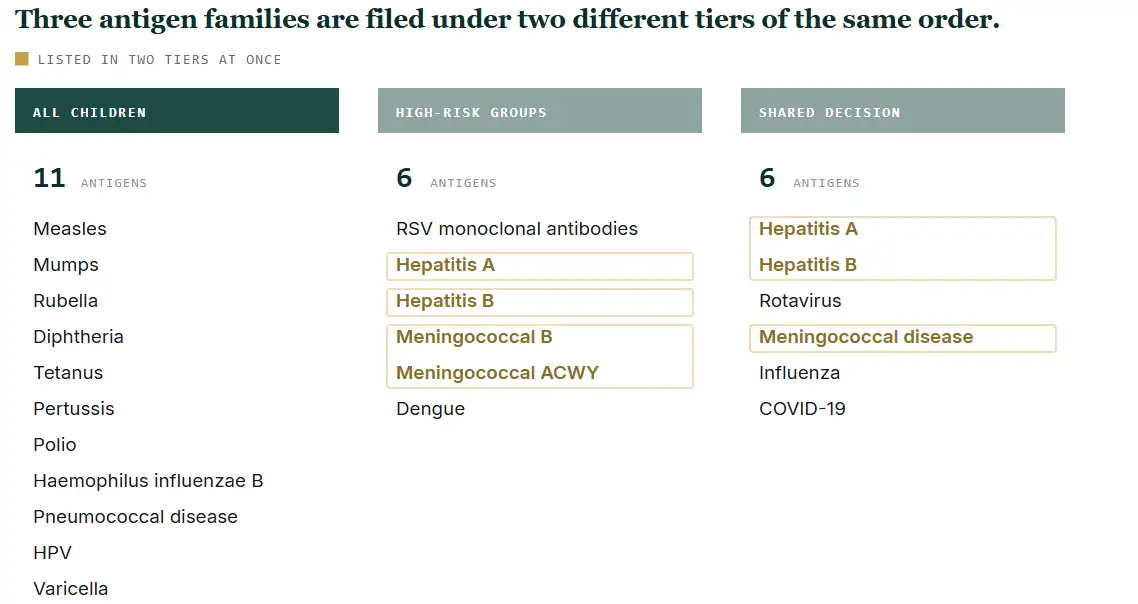
- Three antigen families sit in two tiers at once. Hepatitis A, hepatitis B and meningococcal disease each appear in both the high-risk category and the shared clinical decision-making category of the same order. No payer can write a coverage policy against that.
The order’s list is the part being reported and the least consequential part of the document. Coverage in the United States runs through an ACIP recommendation adopted by the CDC, which is what the Affordable Care Act and the Vaccines for Children programme both key to, and an executive order cannot supply either. What the order can do sits in Sections 3 and 4: a procurement instruction for products that have not existed since 2009, and a litigation instruction aimed at state school-entry law. A reader can stop here with the full picture. The sections below are the detail.
The order cannot move a coverage dollar, and its own text concedes it
The order signed on 10 August 2026 names eleven immunisations for all children: measles, mumps, rubella, diphtheria, tetanus, pertussis, polio, Haemophilus influenzae type B, pneumococcal disease, HPV and varicella. That is seven fewer than the eighteen the American Academy of Pediatrics carries on its own 2026 schedule, and the Academy called the order dangerous while confirming its schedule stands unchanged.
None of that alters an obligation. Coverage without cost-sharing under the Affordable Care Act attaches to an ACIP recommendation once the CDC adopts it, and Vaccines for Children eligibility keys to the same votes. An executive order supplies neither. Section 2(c) asks agencies only to act to the fullest extent allowable by law, and Section 5(c) closes by disclaiming any enforceable right.
Section 1 is candid about why the order takes this form. It records that the earlier directives, the memorandum of 5 December 2025 and Executive Order 14407 of 29 May 2026, have been delayed by litigation over the composition of ACIP and over the schedule itself. A district court stayed the January schedule on 16 March and the government appealed on 29 April. This order routes around a blocked instrument rather than replacing one.
The insurer pledge lost its anchor date in May, and that is the real exposure
Since September 2025 the sector has treated one voluntary commitment as the floor under paediatric vaccine access, and its original wording is what made it a floor. Health plans would cover all ACIP-recommended immunisations that were recommended as of 1 September 2025, with no cost-sharing, through the end of 2026. Two words carried it: as of. The promise was pinned to a fixed snapshot, so a later narrowing of the federal schedule could not reach it.
The statement published now, marked updated as of May 2026, reads differently. Member plans will continue covering all ACIP-recommended immunisations with no cost-sharing through the end of 2027. The term extended by a year. The date anchor came out.
That is no longer a hedge against schedule change. It is a floating reference to whatever ACIP recommends at the time. If the appeal succeeds, or ACIP is reconstituted and votes a narrower schedule, the pledge narrows with it automatically and without announcement. The association’s members cover more than 200 million Americans. Self-funded employer plans set their own terms and were never inside it, and neither were families without private cover. Anyone modelling US paediatric volumes off the 2027 pledge is modelling off a moving reference and should say so in the assumption line.
Three antigen families are in two tiers at once, which is not something a payer can write against
Section 2(a) sorts childhood immunisation into three categories. The second covers high-risk groups, the third shared clinical decision-making. Hepatitis A and hepatitis B appear in both. Meningococcal B and ACWY sit in the second while meningococcal disease sits in the third.
The three categories set out in Section 2(a) of the order, reproduced in the sequence the text uses. Gold marks an antigen family that appears in more than one category.
Executive order text as signed · 10 August 2026 · Categories as written, not reconciled
The two designations are not interchangeable. They differ on what a plan must cover, what Vaccines for Children supplies, and how a paediatrician raises the subject in a fifteen minute visit. Plans have historically varied in whether a shared decision-making designation triggers no-cost coverage, while Medicare and Medicaid have been required to treat it as one. Filing the same antigen under both does not create optionality. It creates an item no coverage policy can be drafted against, which defaults in practice to whatever the plan was already doing.
Section 3 orders a procurement plan for products discontinued in 2009
Section 2(b) states that MMR should be given as three separate single-disease shots once such products are domestically available, and that all childhood immunisations should be given at separate visits to the maximum extent feasible. Section 3(a) gives the HHS Task Force on Safer Childhood Vaccines 90 days to present plans for offering single vaccines, starting with MMR.
Monovalent measles, mumps and rubella vaccines have not been available in the United States since production was phased out in 2009, a commercial decision taken once the combination product had taken the market. Restoring them means three licensure processes, three sets of clinical work and retooled fill capacity, for a market the order splits into thirds. Section 5(b) makes the order subject to the availability of appropriations, and no purchase commitment, volume floor or exclusivity is attached.
Section 3(c) has the widest reach and the least attention. It directs work on alternative adjuvants to aluminium, together with comparative safety and efficacy studies. Aluminium salts sit across much of the paediatric portfolio, so a federally sponsored comparative programme against a class-wide adjuvant is a multi-year reformulation question reaching well beyond the products named in Section 2.
The transmission runs through state school-entry law, which is what Section 4 is for
Federal recommendations inform. State school-entry requirements compel. That gap is why Section 4 matters more than Section 2. It directs the Attorney General toward legal actions challenging state laws on parental authority, religious freedom, disability accommodations and equal protection, including state obligations to provide religious and medical exemptions from immunisation requirements. Section 4(b) extends the same posture to departmental contractors and grantees, and Section 2(d) advises states to review their school enrolment rules directly. Broadening exemption law changes uptake without touching a schedule, a coverage rule or a reimbursement code. It is the fastest route to volume change and the least visible in a coverage model.
For the next four quarters the exposure is a demand question rather than a coverage question, concentrated in the RSV monoclonal, hepatitis, meningococcal, rotavirus, influenza and COVID-19 franchises rather than the retained eleven. Coverage risk arrives later, through two gates worth watching together: the appeal of the March stay, and whether the next published version of the insurer commitment restores a date. The first is public record. The second will not be announced.