
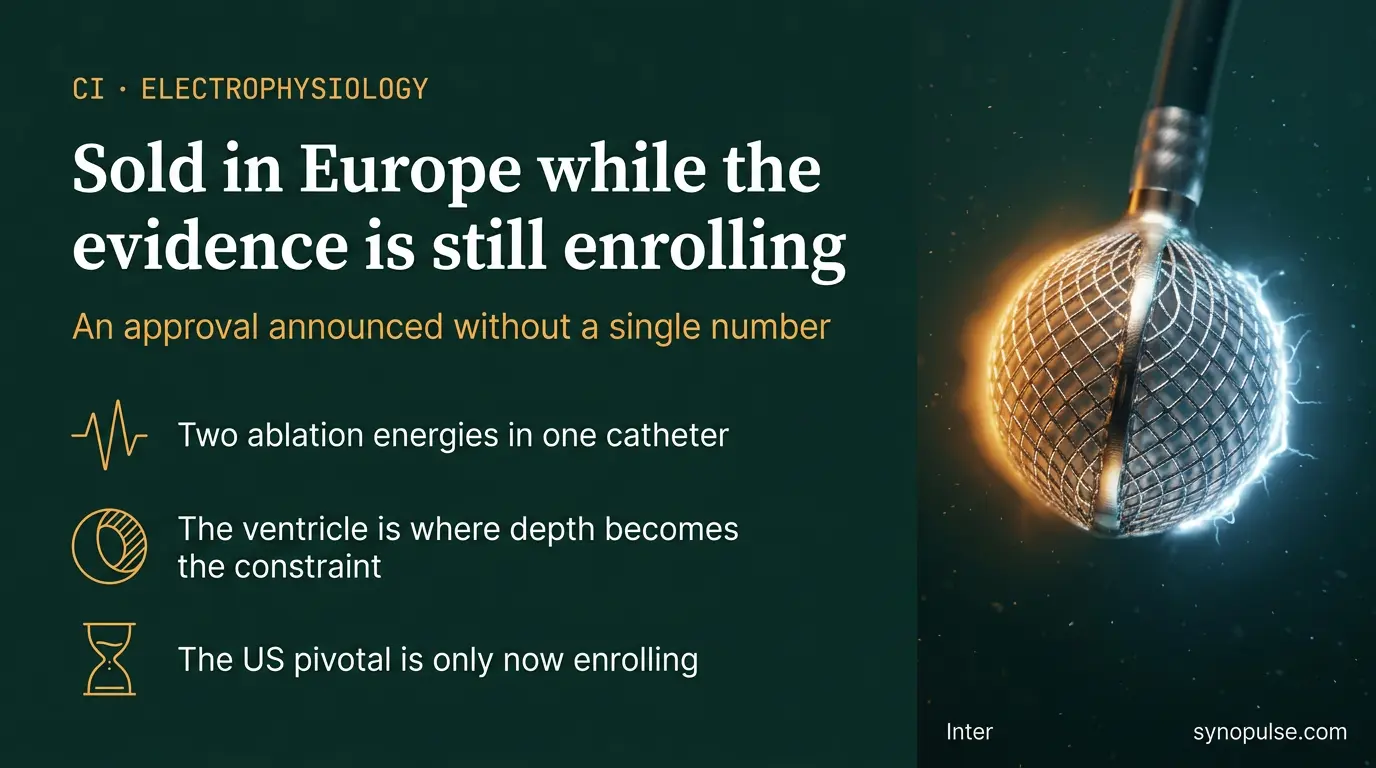
Sphere-9 Can Ablate VT in Europe While Its US Pivotal Is Still Enrolling
- Medtronic announced an expanded CE Mark indication for the Affera Mapping and Ablation System with Sphere-9 Catheter covering ventricular arrhythmias, including ventricular tachycardia and premature ventricular complexes. Sphere-9 is the first all-in-one mapping and ablation, large-tip focal, dual-energy catheter CE marked for ventricular ablation.
- The catheter combines pulsed field and radiofrequency ablation with high-definition mapping in a single device, so one catheter maps and ablates using either energy.
- The FDA granted Breakthrough Device Designation for Sphere-9 in ventricular arrhythmias, and the Sphere VT US pivotal trial intended to support future US approval is now enrolling.
- Medtronic’s own framing is that catheter ablation for VT is an established option but outcomes have remained suboptimal, with little ablation tool innovation in recent years. The release contains no efficacy or safety data and names no supporting study.
CI read
An approval has been granted in a life-threatening indication and the announcement carries no numbers. No efficacy figure, no safety figure, no trial named. Set that beside the other fact disclosed in the same release, that the US pivotal is only now enrolling, and the shape is clear. Europe is where the device is sold while the evidence is assembled, and the United States is where the evidence is required before it can be. That is not a criticism of Medtronic, it is how the two systems are built, but it is worth saying plainly, because patients on either side of that line will wait very different lengths of time.
- The ventricle is a harder problem than the atrium, which is what makes this position worth holding. Pulsed field ablation has spent years proving itself almost entirely in atrial fibrillation, where the tissue is thin and the safety argument writes itself. Ventricular myocardium is several times thicker, so lesion depth becomes the binding constraint and pulsed field alone struggles to reach. A catheter carrying both energies answers exactly that: radiofrequency where depth is needed, pulsed field where proximity to critical structures makes thermal injury the greater risk. A first CE Mark in the ventricle is therefore a category position rather than a label extension, and it is the reason to treat this as more than a routine indication expansion.
- Breakthrough Device Designation buys interaction, not evidentiary latitude. The same point applied to NeuroPace earlier this month and it applies here. Designation shortens the conversation with the agency, it does not shorten the trial. Sphere VT still has to enrol, follow up and read out, and a US launch should be dated from that readout rather than from the designation announcement. Anyone modelling this on the designation alone is modelling a press release.
- The number to demand sits in the health economics, not the acute result. Medtronic’s own citations point at cost and 30-day readmission after VT ablation, which is the correct frame. VT ablation is expensive, patients return, and the commercial case for a better tool is readmission avoided rather than minutes saved in the lab. So the figure to ask for from European experience is not acute procedural success, it is VT recurrence and repeat hospitalisation at twelve months. Until that is published, the claim rests on catheter design rather than on outcomes, and European centres adopting now are generating the evidence rather than acting on it.