
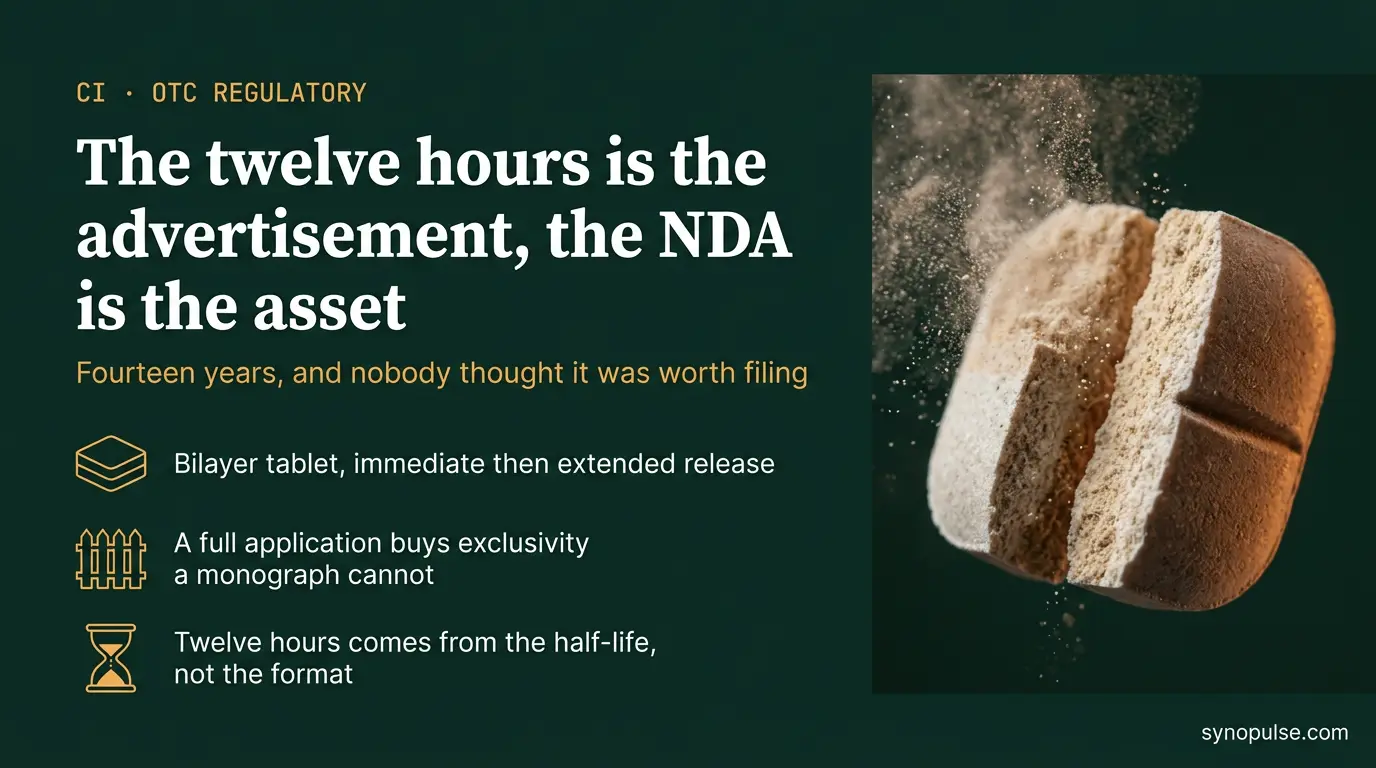
Reckitt’s Real Innovation at Mucinex Is the NDA, Not the Twelve Hours
- The FDA approved Mucinex 12HR Cold & Fever Multi-Symptom, which Reckitt describes as the first OTC innovation in the cold and flu category in 14 years and the first New Drug Application under the Reckitt name to win approval. It is the fourth FDA approval across the Mucinex family and is already at retailers nationwide.
- The product is the first in its category to combine guaifenesin as an expectorant, dextromethorphan HBr as a cough suppressant and naproxen sodium, an NSAID, for fever and pain, in a patented bilayer tablet delivering immediate and extended release from a single dose.
- The claim is relief from fever, cough, chest congestion and body pain for 12 hours, described as lasting up to three times longer than most cold and flu medications, measured against one dose of a four-hour medicine without re-dosing.
- Development took more than a decade. The unmet-need claim is footnoted to Reckitt’s own 2022 usage and attitudes research, and the release carries no safety information of any kind.
CI read
The twelve hours is the advertisement. The NDA is the asset. Nearly every OTC cold and flu product in the United States is sold under the monograph system, which demands no approval and confers no protection, which is exactly why a store brand can copy a Mucinex formulation the week it ships and why the franchise has spent years defending shelf space against its own generic reflection. Reckitt has now spent more than a decade and a New Drug Application climbing out of that system. What it bought is not a longer dosing interval. It is the first defensible position anybody has held in this category in a very long time.
- The combination is what forced the NDA, and the NDA is what builds the moat. Guaifenesin and dextromethorphan sit comfortably inside the monograph. Adding naproxen sodium to them in a bilayer extended-release tablet does not, so approval had to come through a full application supported by clinical work. That route is slow and expensive, and it is also the only route in this category that yields regulatory exclusivity and a patent worth pointing at. Fourteen years without an innovation is not evidence that the category was finished. It is evidence that until now nobody believed the return justified the filing.
- Competitive frame: the twelve hours comes from pharmacology, not formulation cleverness. Naproxen sodium is the only widely used OTC antipyretic with a half-life long enough to carry a 12-hour claim, where acetaminophen and ibuprofen cannot. The differentiation therefore rests on an ingredient choice any competitor is free to copy, and the durable barrier is the bilayer patent and the exclusivity rather than the duration itself. Expect the next filings in this category to reach for the same analgesic. The numbers to demand are the exclusivity expiry and the bilayer patent term, because those two dates, not the claim on the carton, are what the franchise is actually worth.
- What to watch, starting with what the release does not say. There is no safety language anywhere in it, which is a conspicuous omission for a product whose novel ingredient is an NSAID being taken by people with fever, who are frequently dehydrated and often older. NSAID class warnings on cardiovascular and gastrointestinal risk will sit on the carton even though they sit nowhere in the announcement, and pharmacist counselling against acetaminophen-based alternatives is what decides repeat purchase in a self-care category. Note the launch too: approved and on shelves nationwide in the same week, meaning inventory was built well before the decision came. That is a confident company, and it is a useful contrast to hold against every launch that arrives two months after its approval.