
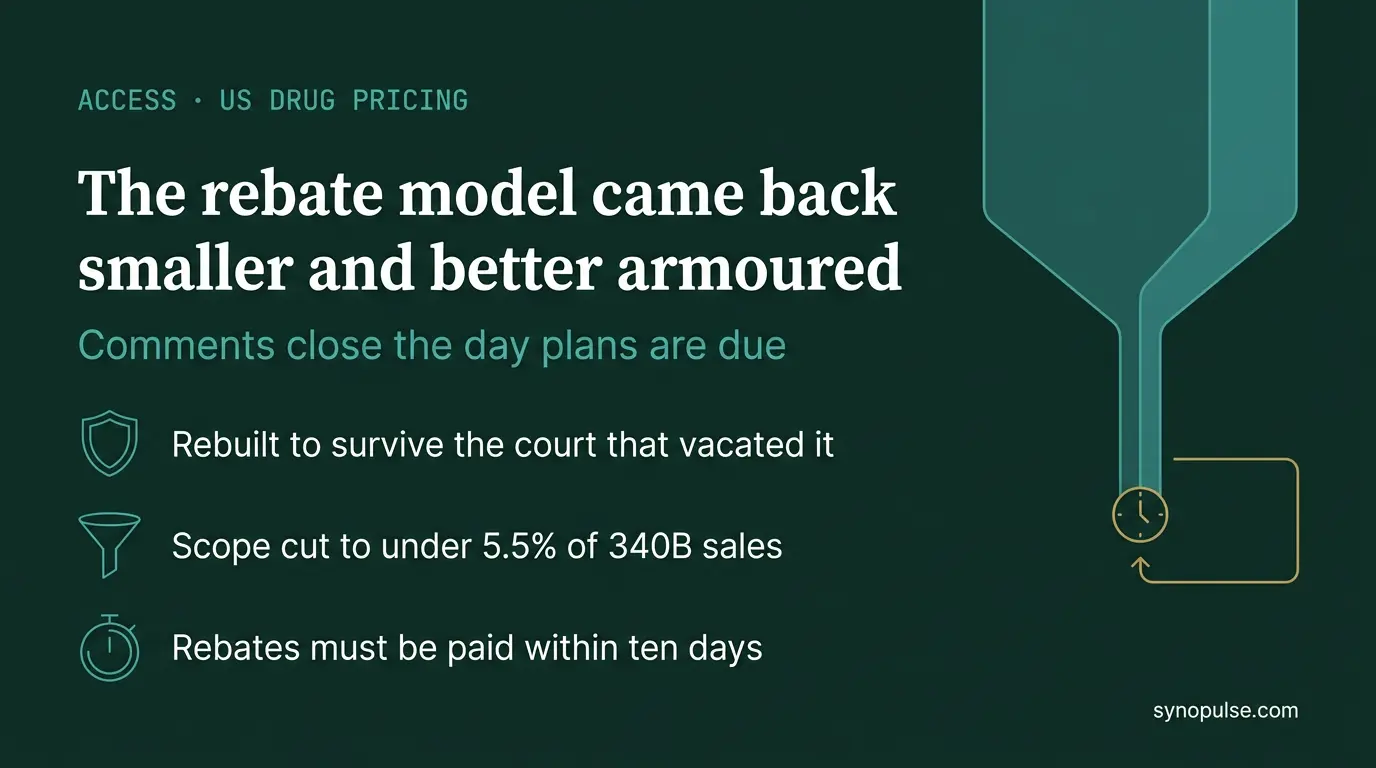
The 340B Rebate Pilot Is Back at Under 5.5% of Sales, Rebuilt to Survive the Court That Killed It
- HRSA published a revised 340B Rebate Model Pilot in the Federal Register on 3 August 2026 (91 FR 48883), effective immediately as published. Manufacturers holding Medicare-negotiated drugs must submit rebate plans by 24 August 2026 for an effective date of 1 January 2027, covering selected drugs for initial price applicability years 2026 and 2027.
- Scope is deliberately small. On 2025 data the included products represent under 5.5% of total 340B sales, leaving 94.5% on upfront discounts through 2027. The programme around it reached roughly $100 billion in 340B-priced purchases in 2025, across 15,249 covered entities and 49,214 associated sites.
- The mechanics answer what killed round one. Rebates must be paid within 10 calendar days of a complete claim, processing is at unit level rather than full-package accumulation, there is a 15-day grace period for unreplenished accumulations, manufacturers must fund the IT platform, and HRSA can start removal proceedings against a manufacturer denying or delaying more than roughly 5% of transactions without justification.
- HRSA priced the burden itself at $523,345,680 a year across covered entities, about $34,320 each, and judged it modest against the programme’s scale. The comment period closes 24 August 2026, the same day manufacturer plans are due.
Access read
Read the dates before the policy. The comment period closes on 24 August, manufacturer plans are due 24 August, and the notice took effect on publication. Comments are not gating anything here. This is a decision with a consultation attached, and the pilot was designed on the assumption that it survives the consultation rather than being shaped by it.
- Round one died on procedure, not merits, and this version is built for the courtroom. The District of Maine enjoined the 2025 notice in December, the First Circuit refused a stay, HHS dismissed its own appeal, and the court vacated in February. What returned is the same policy wrapped in an administrative record: twenty-one pages, roughly 2,475 comments answered, an IQVIA cash-flow analysis pricing rebate interest at 0.19% for entity-owned pharmacies and 0.03% for contract pharmacies, and scope cut to under 5.5% of 340B sales. Every one of those is aimed at an APA challenge rather than at hospitals, and the narrow scope is the strongest signal of all: you do not shrink a pilot to a twentieth of the programme unless you expect to defend it.
- For manufacturers, the rebate is the vehicle and the claims data is the cargo. Ten-day payment, unit-level processing rather than full-package accumulation, manufacturer-funded platforms and a removal threshold near 5% are real concessions that give covered entities enforceable terms the last version lacked. Accept them, because what arrives alongside is the deduplication mechanism manufacturers have wanted since 2024, attached to claims-level detail on which dispense was 340B. That visibility is worth more than the working-capital float it costs. Note that over 10,000 covered entities are already registered on a rebate platform: the infrastructure was built while the litigation ran.
- The number to watch is HRSA’s own. The agency put $523,345,680 a year of administrative burden into the record, roughly $34,320 per covered entity, then argued it was modest against a programme that bought about $100 billion at 340B prices in 2025. Both halves of that sentence will be read back in a filing. If the pilot holds through 2027, the question stops being whether rebates replace upfront discounts and becomes how fast the 94.5% still on upfront pricing follows, because the platform, the claims standard and the legal precedent will all already exist.