
Congress Exempted the Medically Frail. The Coding System Cannot Find Them.
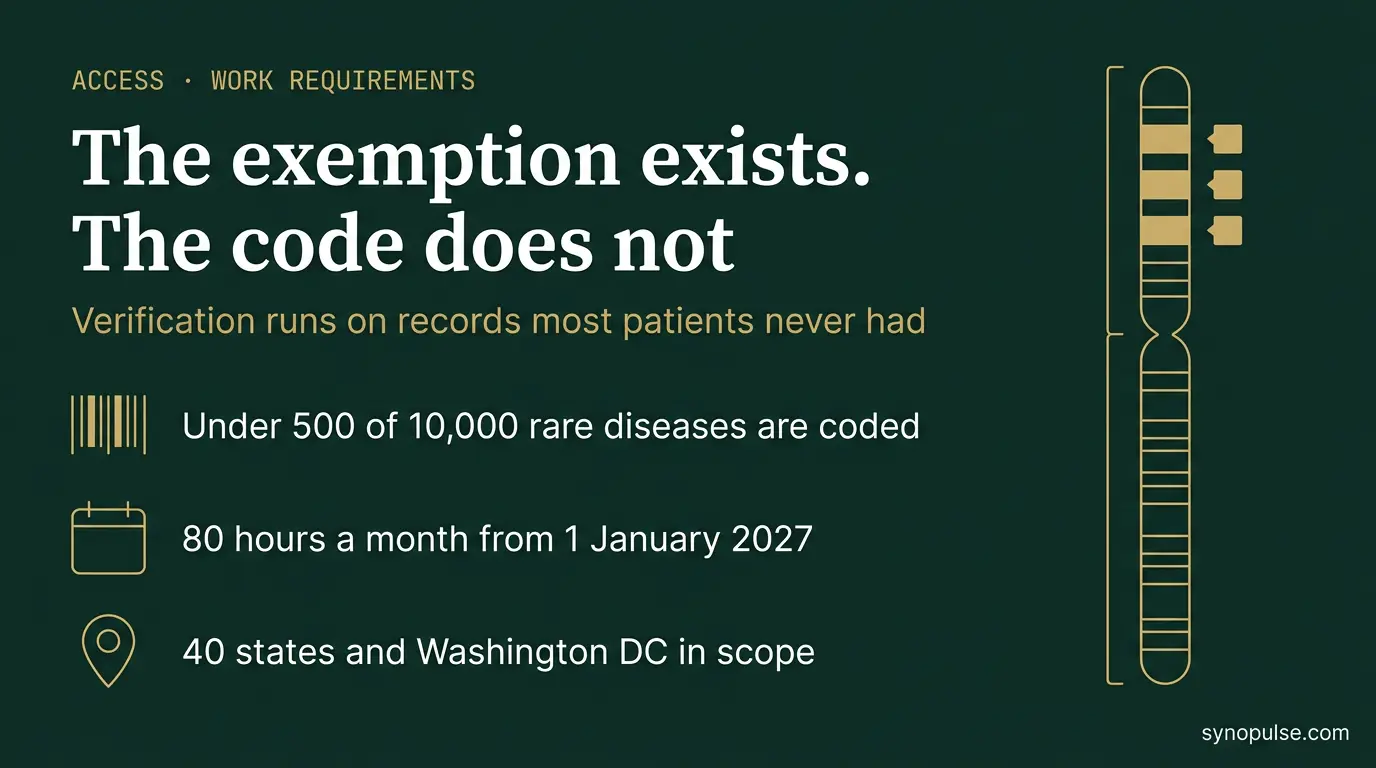
Fewer than 500 of the more than 10,000 known rare diseases carry a unique ICD-10 code. From 1 January 2027, Medicaid expansion enrollees across 40 states and Washington DC must log 80 hours a month of work, study, volunteering or job training to keep coverage. Congress exempted the medically frail. CMS then decided that frailty has to be demonstrated as functional impairment and, from 2028, corroborated by health data. The exemption is real. For most rare disease patients, the record that would prove it was never created.
Congress wrote a clinical exemption. The rule turned it into an evidentiary one.
The One Big Beautiful Bill Act, signed in July 2025, requires Medicaid expansion enrollees aged 19 to 64 to complete 80 hours a month of qualifying activity, and exempts those who are medically frail. That much was settled a year ago.
The interim final rule CMS issued at the start of June changed what frailty means in practice. Carrying a serious or complex condition is no longer sufficient on its own. The enrollee must also show the condition significantly impairs their ability to meet the requirement, evidenced as functional limitation across ordinary tasks such as eating, bathing and walking. Legal analysts noted immediately that this second test appears nowhere in the statute. Forty-eight patient organisations, among them the American Lung Association, the Crohn’s and Colitis Foundation and the National Alliance on Mental Illness, said the interpretation conflicts with the law as written. Democratic attorneys general took the question to a district judge on 28 July, and the ruling will govern the exemption in more than two dozen states.
Set the legal argument aside for a moment. The operational problem is more immediate, and it is arithmetic.
Verification runs on diagnosis codes, and rare disease is mostly uncoded
States will confirm frailty using what they already hold: diagnosis codes, claims records, prescription histories, hospitalisation data. That works when a condition has a name the system recognises. Fewer than 500 rare diseases do. The remaining nine and a half thousand resolve to an unspecified code, to a code for a symptom rather than a disease, or to no code at all. NORD’s formal comment, filed on 31 July ahead of the deadline, asks CMS to accept clinician attestation and other clinical evidence precisely because diagnosis codes cannot carry the weight the rule places on them.
The mismatch compounds from there. Patients still working through a diagnostic odyssey have no code by definition. Patients whose function fluctuates will document a good month and a bad one, with no rule for which counts. Patients in clinical trials, often the only treatment route available in rare disease, may need to travel or relocate for care, and nothing in the rule credits that as qualifying activity. NORD asked for it to be. Caregivers of medically complex adults sit outside the exemption written for parents of disabled children under 14.
Self-attestation absorbs some of this through 2027, but states choose whether to offer it and the permission expires. From 2028 the enrollee has to produce data the system was never built to generate.
The early states already show the shape of the failure
Nebraska launched in May and begins verifying enrollee status this month. Arkansas soft-launched on 1 July with penalties held back until January, and Montana and Iowa are also moving ahead of the federal deadline. Arkansas is the instructive case because it has run this experiment before. Its 2018 programme left roughly 18,000 people uninsured before a federal judge struck it down. A third of those affected did not know the policy existed. More than half of those who had heard of it did not know it applied to them. New Hampshire paused its own version in 2019 once it modelled the likely coverage losses.
The Congressional Budget Office put the national effect at 5.3 million additional uninsured by 2034 from the work requirement alone. A recent study of low-income Medicaid adults found roughly half would be at risk of disenrollment despite documented serious health impairment. Those are not people gaming the system. They are people the system cannot resolve.
The cost lands on the enrollees who are most expensive to lose
Average Medicaid spend for a disabled enrollee runs near $21,000 a year, close to triple the figure for the average American. That number usually gets read as an expense. Read it the other way and it measures clinical dependence: these are the enrollees for whom a gap in coverage converts directly into a missed infusion, an interrupted enzyme replacement, or a five dollar copay that becomes a four figure price at the pharmacy counter.
For manufacturers carrying rare disease franchises this is a continuity problem rather than an abstraction. Medicaid is a primary payer across much of the orphan portfolio. Eligibility churn during a redetermination cycle surfaces as gaps in persistence, as restarts on therapies where restarting is clinically fraught, and in gene therapy specifically as a coverage status that has to hold on the single day of administration. Standing up frailty adjudication inside six months, across 40 states with 40 interpretations, is a schedule that produces administrative error, and error here defaults to disenrollment rather than to review.
The transferable lesson is about infrastructure, not generosity
This rule is being argued as a dispute over who deserves coverage. The more durable point is narrower and much harder to legislate around: an eligibility test is only as good as the data infrastructure asked to execute it. Congress named a protected class. CMS then defined that class in terms of a record which, for most of the people inside it, has never existed.
The pattern is not confined to Medicaid or to the United States. Every system now moving toward automated eligibility, claims-led verification and algorithmic risk stratification inherits the same blind spot, and it falls hardest on small populations with heterogeneous presentations and no standard code. Rare disease is the extreme version, which is what makes it the useful one to watch. Whatever the district court decides about the ability to work test, the coding gap survives the ruling, and January is five months away.