
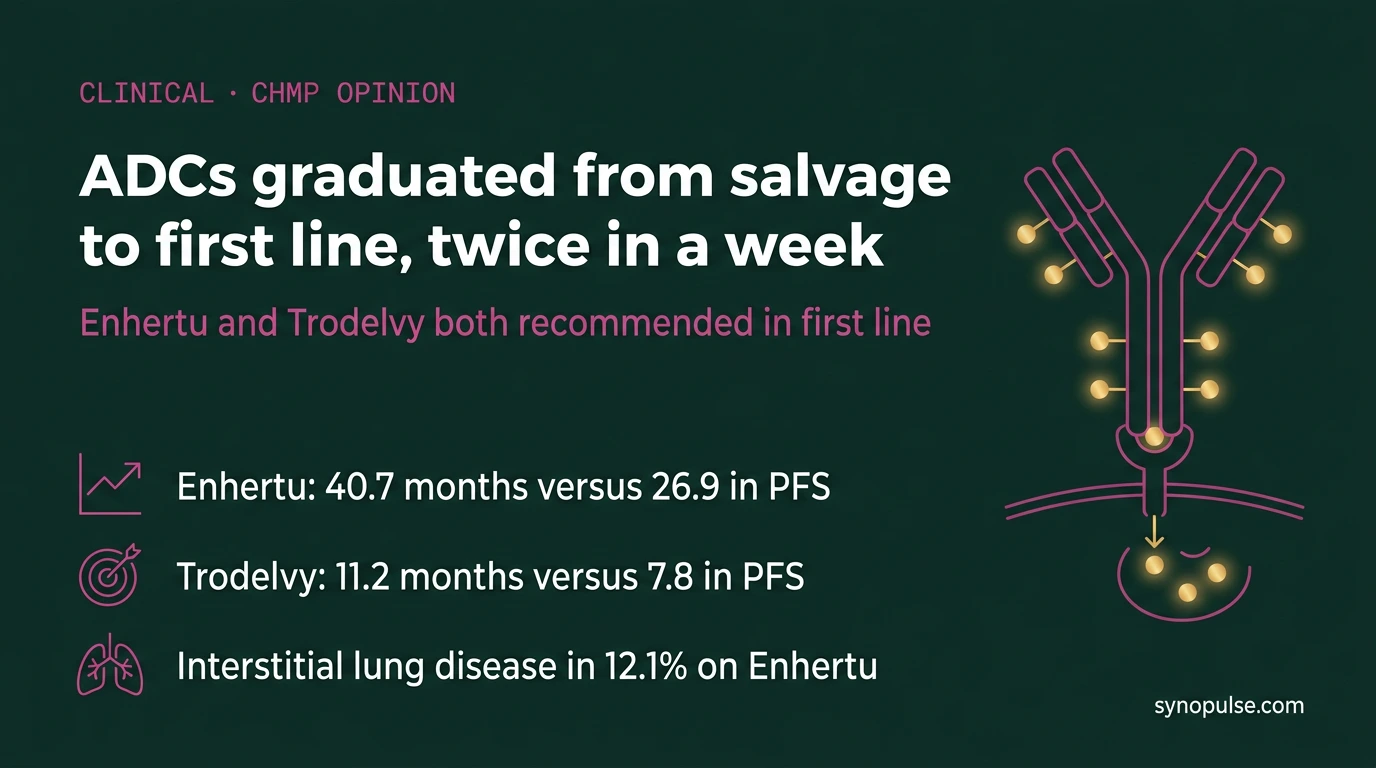
ADCs Graduated From Salvage to First Line, Twice in a Week
- The CHMP adopted positive opinions on two antibody-drug conjugate combinations for first-line metastatic breast cancer within days of each other.
- Enhertu plus pertuzumab (AstraZeneca and Daiichi Sankyo) in first-line HER2-positive disease, on DESTINY-Breast09: a 44 percent reduction in risk of progression or death versus taxane, trastuzumab and pertuzumab (HR 0.56, p<0.00001), with median PFS of 40.7 months against 26.9. AstraZeneca calls it the first major change in this setting in over a decade.
- Trodelvy plus Keytruda (Gilead and Merck) in first-line PD-L1-positive triple-negative disease (CPS ≥10), on ASCENT-04/KEYNOTE-D19: a 35 percent reduction (HR 0.65, p<0.001), median PFS 11.2 months against 7.8. It is Gilead’s second first-line opinion this year, after May’s for PD-(L)1-ineligible patients, which together would make Trodelvy a backbone across PD-L1 status.
- Overall survival is not mature in either. In DESTINY-Breast09 the interim OS hazard ratio was 0.84 with a confidence interval crossing one, at 16 percent maturity.
Clinical read
The class that was built to rescue patients who had run out of options is now being recommended as the first thing they receive, and two opinions in one week is the moment that becomes undeniable. The commercial logic is stark: in metastatic breast cancer more than half of patients never reach a second line, so a therapy confined to later lines reaches a fraction of the people who have the disease. Moving to first line expands the treated population and lengthens time on drug at the same time. Two things deserve more attention than they will get. The first is the gap between the two results, 13.8 months of additional progression-free survival for Enhertu against 3.4 for Trodelvy, which are not comparable diseases but are being greeted with the same language, and in both cases overall survival has not matured. The second is exposure. Enhertu carried interstitial lung disease in 12.1 percent of patients in DESTINY-Breast09, including two fatal events. A toxicity profile that is acceptable when a patient has exhausted alternatives is a different calculation when the same drug is given first, for longer, to patients who have other options. Note also what these approvals do to the older biologics: the ADC becomes the backbone and trastuzumab-era pertuzumab and Keytruda become the partners riding alongside it, which reverses the relationship those franchises were built on and gives each a new first-line indication at a convenient moment.