
Spain rewrites its drug-pricing rulebook, and the price of a generic will now fall as it sells more
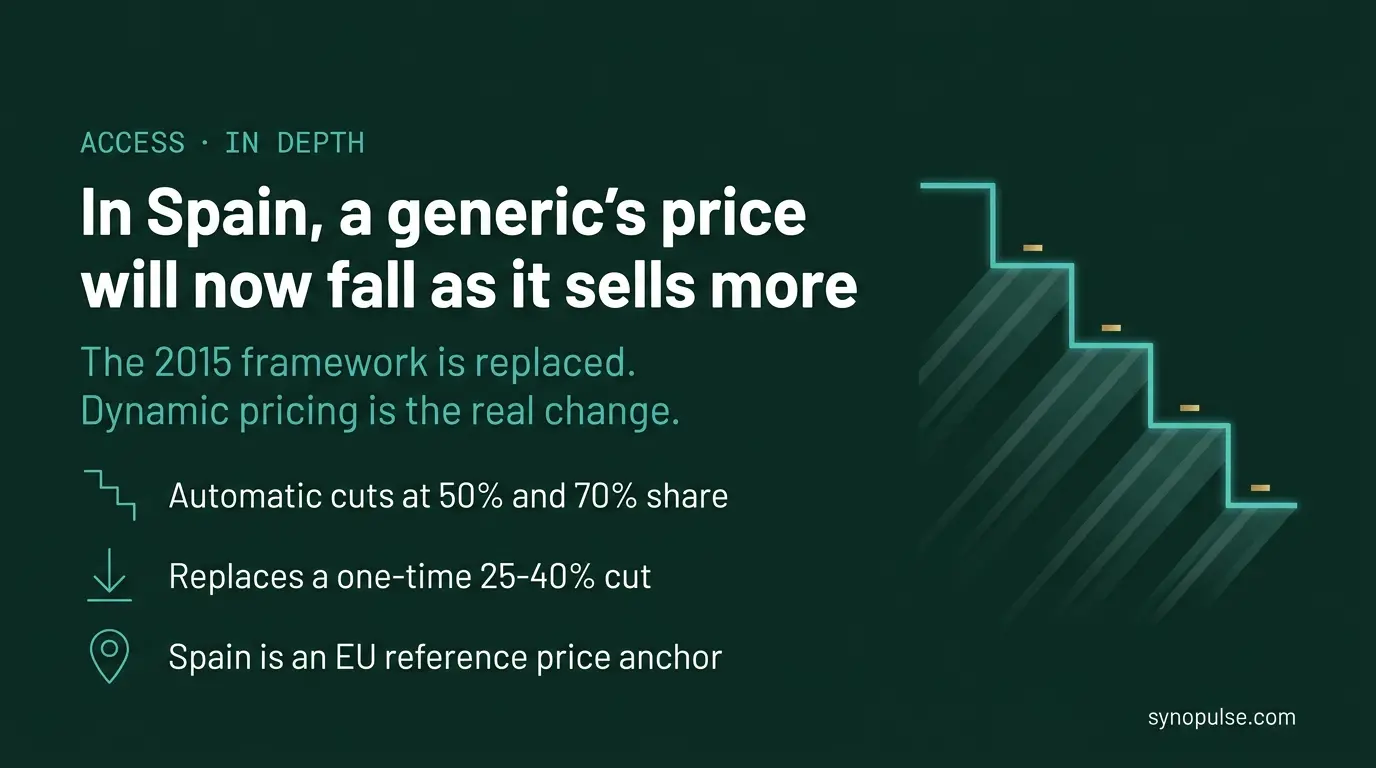
- Spain’s Council of Ministers approved a draft Medicines Law on 21 July that replaces the 2015 framework, and its most consequential change is dynamic pricing: off-patent drugs will face automatic, progressive price cuts as their market share crosses thresholds such as 50 and 70 percent.
- This breaks the current model, where the first generic or biosimilar triggers a one-time 25 to 40 percent cut and prices then go static. Under the new rule, rising volume keeps pushing price down, which reshapes the economics of every off-patent portfolio sold into Spain.
- A new “strategic medicine” designation lets the regulator prop up supply-vulnerable essential drugs, and a conditional, pay-for-results financing route lets innovative drugs enter reimbursement early with clawback if real-world results or final price disappoint.
Spain is the fourth-largest EU pharma market and, critically, a reference country other European systems price against. So a pricing overhaul here does not stay in Spain: it propagates. The headline abroad will be “modernisation,” but the mechanism that matters is dynamic pricing, which turns market success into automatic price erosion for generics and biosimilars, and that is a structural change to how off-patent money is made across Europe’s reference-pricing web. A reader can stop here with the full picture; the sections below are the detail.
What actually changed: from a one-time cut to a falling floor
The reform keeps reference pricing as the general ceiling for equivalent drugs, reviewed annually, but adds a second, parallel system for off-patent medicines. The rule is strict: a given drug is subject to one system or the other, never both. Under dynamic pricing, as a generic, hybrid or biosimilar gains share in a consolidated market, the state automatically ratchets its industrial price down at defined penetration thresholds. The Ministry names 50 and 70 percent as examples.
To see why that is a break, look at what it replaces. In Spain today, the first generic or biosimilar entry forces a 25 to 40 percent discount, and after that, prices sit static. Competition, such as it is, happens as wholesale discounts negotiated between pharmacies and manufacturers, not as falling public prices. The new model imports something closer to the Swedish idea, where price competition is continuous, but does it through automatic regulatory cuts rather than a free market. The direction is the same: success no longer locks in a price, it lowers it.
The detail manufacturers will read twice: coexisting prices in one group
Within a single homogeneous group, the reform lets products sit at different price points. The state guarantees full coverage of the most efficient options; a patient who wants a specific higher-priced brand can have it by paying the difference on top of the usual copay. For originators, that is a narrow escape valve, a way to keep a branded price alive in an off-patent group, but only for the patient willing to pay out of pocket, which in practice is a thin slice of demand. It preserves optionality without preserving revenue.
Supply security becomes a pricing lever
The new “strategic medicine” category is the supply-shortage answer, and it cuts both ways for industry. It lets AEMPS apply special economic and regulatory measures to keep an indispensable, supply-vulnerable drug on the market, which can mean protecting a price that would otherwise be cut to unviability. That is a genuine, and rare, upward pressure in an otherwise cost-containment reform. Reporting on the draft noted that a manufacturer’s ability to guarantee supply and prevent shortages would itself influence pricing and reimbursement decisions, so reliability is becoming a priced attribute, not just a compliance expectation.
Spain is an external reference-pricing anchor for other European countries. When a Spanish price falls, systems that benchmark against Spain can follow it down, and the risk of parallel export rises. That is the real reason a national reform is a continental event: dynamic pricing does not just lower Spanish generic prices, it lowers the reference point that other regulators cite. For any company modelling European off-patent revenue, the erosion curve just got steeper, and it now bends with volume rather than resetting once. The bill now enters parliamentary passage in the Cortes, so terms can still move, but the architecture is set.