
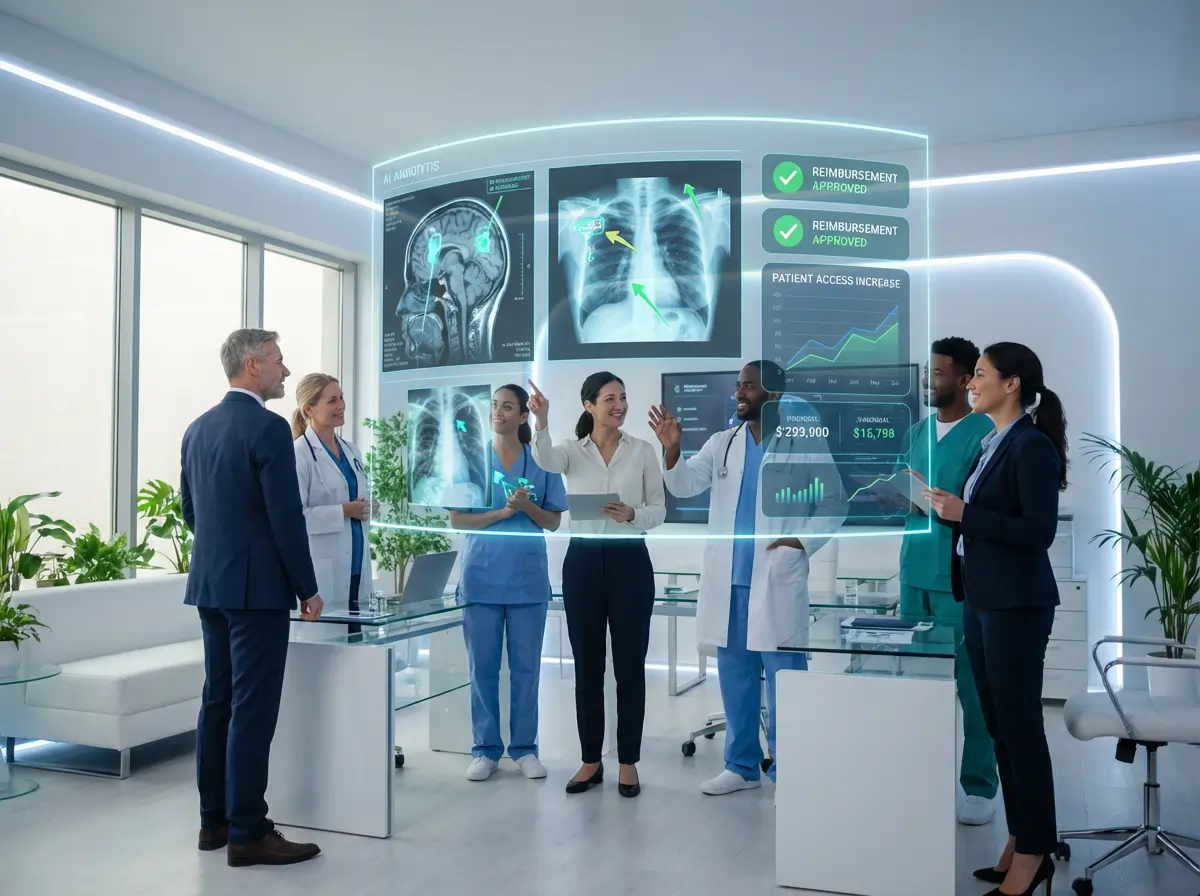
ConcertAI’s TeraRecon launches DETECT™ to align AI imaging with reimbursement realities and widen patient access
ConcertAI’s TeraRecon division has introduced DETECT™, an enterprise platform designed to solve one of the most persistent structural barriers in radiology: AI innovation has advanced rapidly, but reimbursement infrastructure has not kept pace. The result is a widening gap between what AI can deliver clinically and what hospitals can economically sustain. TeraRecon is positioning DETECT as the connective tissue that brings AI biomarkers, clinical workflow, and reimbursement operations into a single, scalable environment.
The company notes that although more than 1,000 FDA-cleared imaging AI tools exist, only a third of billable AI-related claims are actually reimbursed. The friction stems less from clinical questions and more from fragmented workflows eligibility verification, documentation, prior authorization, and claim submission often require manual steps that overburden staff and lead to denials. ConcertAI’s leadership argues that without a reimbursement-aware foundation, hospitals will continue to struggle to adopt AI that they otherwise recognize as clinically valuable.
Eron Kelly, CEO of ConcertAI, said the launch reflects a practical shift in the industry. Hospitals are no longer asking whether AI works, he said they are asking whether integrating AI will overload their systems or disrupt revenue cycles. DETECT is intended to resolve those concerns by automating eligibility detection, improving documentation consistency, and embedding AI into routine reporting workflows without creating parallel processes.
DETECT integrates directly with electronic medical records, reporting systems, visualization tools, and hospital imaging platforms. TeraRecon describes it as a single operational layer that brings reimbursable AI biomarkers into radiology’s existing system architecture. Once integrated, the platform can automatically identify cases eligible for reimbursable AI biomarkers, run the appropriate imaging algorithms, populate structured reports, and prepare the documentation needed for downstream administrative steps. The company says the approach has the potential to reduce dictation time, lower administrative load, and deliver more complete reports for payers.
ConcertAI emphasizes that DETECT is not intended to replace radiologist judgment. Instead, it is a tool that aligns clinical insight with workflow automation so that specialists can concentrate their time on interpretation rather than administrative repetition. Dhiraj Carumbaya, senior vice president and general manager of TeraRecon, said the platform gives clinicians support where they feel pressure most acutely: complexity of cases, time per study, documentation requirements and the expectation to keep up with emerging biomarkers. The company believes DETECT will enable radiologists to spend more time on high-value tasks without sacrificing consistency or compliance.
DETECT is being marketed as a financial and operational solution as much as a clinical one. ConcertAI highlights that hospitals lose significant revenue opportunity when reimbursable biomarkers go unidentified or when claims fail due to incomplete or inconsistent documentation. By introducing automation into eligibility checks and consolidating required reporting elements into a single, audit-ready format, DETECT is designed to reduce denials and increase the predictability of AI-driven services. Real-time dashboards provide insight into claim patterns, reimbursement bottlenecks, and utilization trends, helping imaging administrators allocate resources more effectively.
The company sees expanding reimbursement clarity as essential for AI adoption. Modalities such as liver fat quantification, bone density evaluation and coronary plaque characterization are increasingly tied to established billing codes, but inconsistent documentation has prevented widespread reimbursement. DETECT’s design centers on closing that documentation gap across both radiology and cardiology so that hospitals can scale these biomarkers with confidence.
Related news
Philips Debuts AI DeviceGuide to Enhance Real-Time Navigation in Heart Valve Repair
ConcertAI frames the launch as part of a broader shift in healthcare toward infrastructure-first AI adoption. Rather than focusing solely on accuracy metrics or single-algorithm deployment, hospitals are looking for unified systems capable of supporting multiple biomarkers, integrating with existing IT systems and ensuring alignment with payer requirements. DETECT represents TeraRecon’s strategy to meet that shift head-on, combining workflow automation with AI-driven imaging and text-based clinical signal extraction.
The company’s expansion into reimbursement operations also reflects the maturation of the broader AI imaging market. Early adopters focused on local clinical workflow enhancements. Today, hospital executives want AI that improves throughput, documentation and financial sustainability areas increasingly tied to real-world adoption. With thousands of potential customers across TeraRecon’s existing provider footprint, ConcertAI views DETECT as a catalyst for the next phase of AI scaling across imaging service lines.