
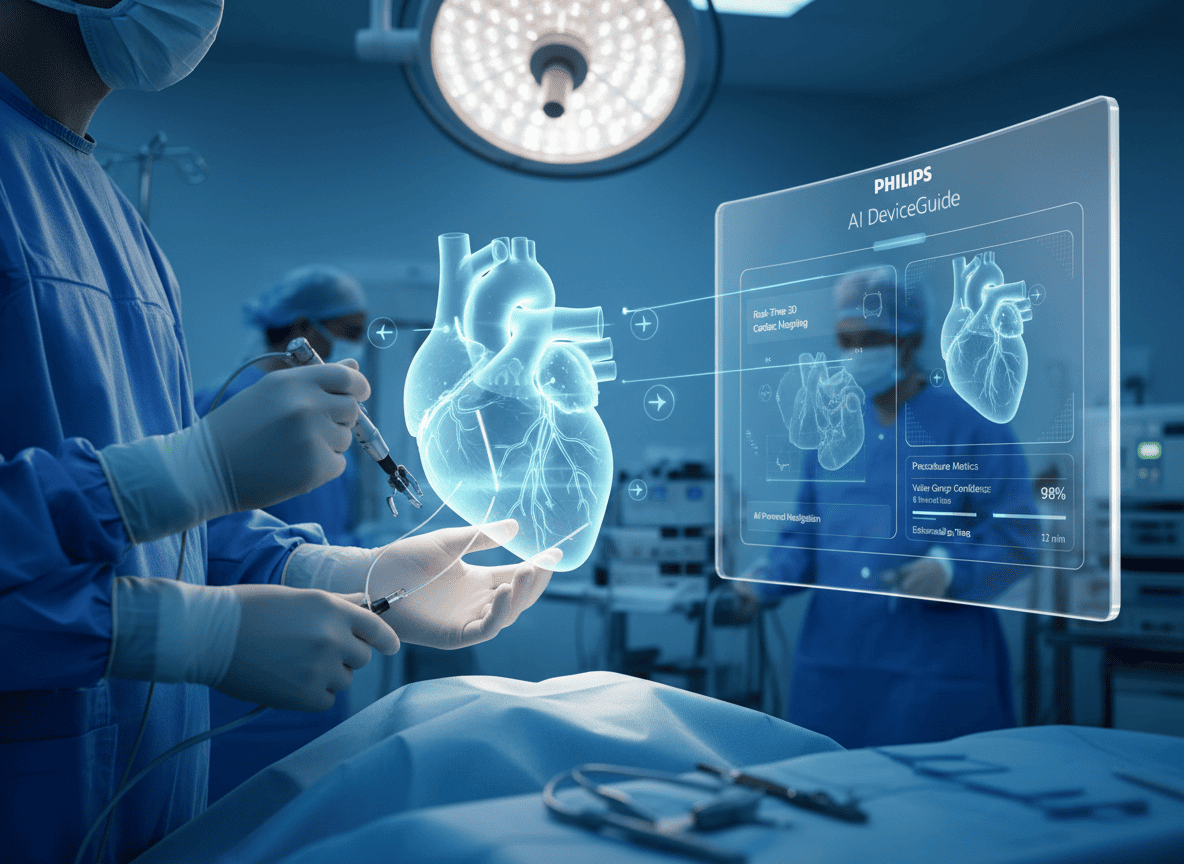
Philips Unveils AI-Powered DeviceGuide to Reinvent Heart Valve Repair Navigation With Real-Time “Bionic Vision”
Royal Philips is bringing artificial intelligence directly into the structural heart procedure room with the introduction of DeviceGuide, an AI-powered device-tracking solution designed to support one of cardiology’s most technically demanding procedures, minimally invasive repair of leaking mitral valves. Previewed at London Valves 2025, the launch marks a major step in Philips’ ambition to merge live imaging, intelligent workflows, and procedural automation in real time.
The company calls it its first AI system designed to actively assist clinicians during the procedure itself. Built on Philips’ EchoNavigator platform, DeviceGuide uses machine learning to continuously track and visualize tiny structural heart repair devices as they move through the beating heart. For clinicians performing mitral transcatheter edge-to-edge repair (M-TEER), this means enhanced clarity in one of the most complex environments in medicine a beating heart with limited visibility, reliance on two imaging modalities, and a need for exact device positioning.
What You Need To Know
- Philips launches DeviceGuide, its first real-time AI-assisted navigation tool for mitral valve repair procedures.
- Philips launches DeviceGuide, its first real-time AI-assisted navigation tool for mitral valve repair procedures.
- Philips launches DeviceGuide, its first real-time AI-assisted navigation tool for mitral valve repair procedures.
- Designed to improve clarity, confidence, and safety during M-TEER procedures for millions with mitral regurgitation.
A Rising Global Burden: 35 Million Affected by Mitral Regurgitation
Mitral valve regurgitation where blood flows backward because the valve does not close properly affects an estimated 35 million adults worldwide. The condition drains energy, causes breathlessness and fatigue, and severely limits everyday activities. For many older or frail patients, open-heart surgery remains too risky. Minimally invasive mitral TEER procedures offer a lifeline, but their precision requirements push the limits of current imaging and operator coordination.
Operators must interpret ultrasound and X-ray simultaneously, align their movements with a second operator, and manipulate miniature devices inside a moving heart under high-stakes conditions. Philips’ goal: reduce cognitive load by giving physicians a single, AI-enhanced visual guide that improves spatial awareness and confidence.
DeviceGuide works by automatically detecting and tracking the tiny repair device using AI algorithms that merge live X-ray and echocardiography. The system then generates a virtual 3D representation of the device superimposed on real-time images of the beating heart.
Clinicians can see not only where the device is located, but also the precise direction it is pointing a crucial detail for successfully grasping valve leaflets and deploying the repair.
Philips describes the tool as offering “bionic vision.” Dr. Gupta explained that the technology is meant to augment, not replace, clinical judgment: “This isn’t about replacing expertise – it’s about amplifying it.”
By giving physicians what amounts to an extra set of AI-enhanced eyes, the company believes DeviceGuide may allow operators to treat more patients safely while reducing variability across experience levels.
DeviceGuide is the result of a strategic collaboration between Philips and Edwards Lifesciences, the global leader in structural heart repair devices. By combining Philips’ expertise in real-time imaging and AI with Edwards’ deep experience in mitral repair technology, the companies redesigned key portions of the procedural workflow to improve navigation, clarity, and interaction between operators.
“DeviceGuide demonstrates the impact of combining leading imaging and therapy expertise,” said Mark Stoffels, Business Leader for Image-Guided Therapy Systems at Philips. He emphasized that similar partnership models will shape the future of AI-enabled interventions as companies integrate device, imaging, and software ecosystems into unified smart platforms.
As structural heart volumes continue to grow especially for mitral and tricuspid valve repair automation and intelligent procedural support are becoming strategic priorities for MedTech leaders. DeviceGuide offers a preview of how AI might increasingly support intra-procedural judgment, enable more efficient training, and potentially democratize advanced interventions beyond high-volume centers.
Related news
Scilex Secures Exclusive Global License for Tokenizing Biotech Assets Through Datavault AI Platform
By embedding AI directly into the live imaging workflow, Philips is signaling a shift from AI as a diagnostic tool toward AI as a real-time procedural partner. For M-TEER cases, where millimeter-level precision determines success or failure, enhanced 3D navigation may represent the next major leap in image-guided therapy.
The technology is not yet commercially available, but its preview at London Valves signals Philips’ intention to accelerate adoption across structural heart centers as regulatory pathways progress.