
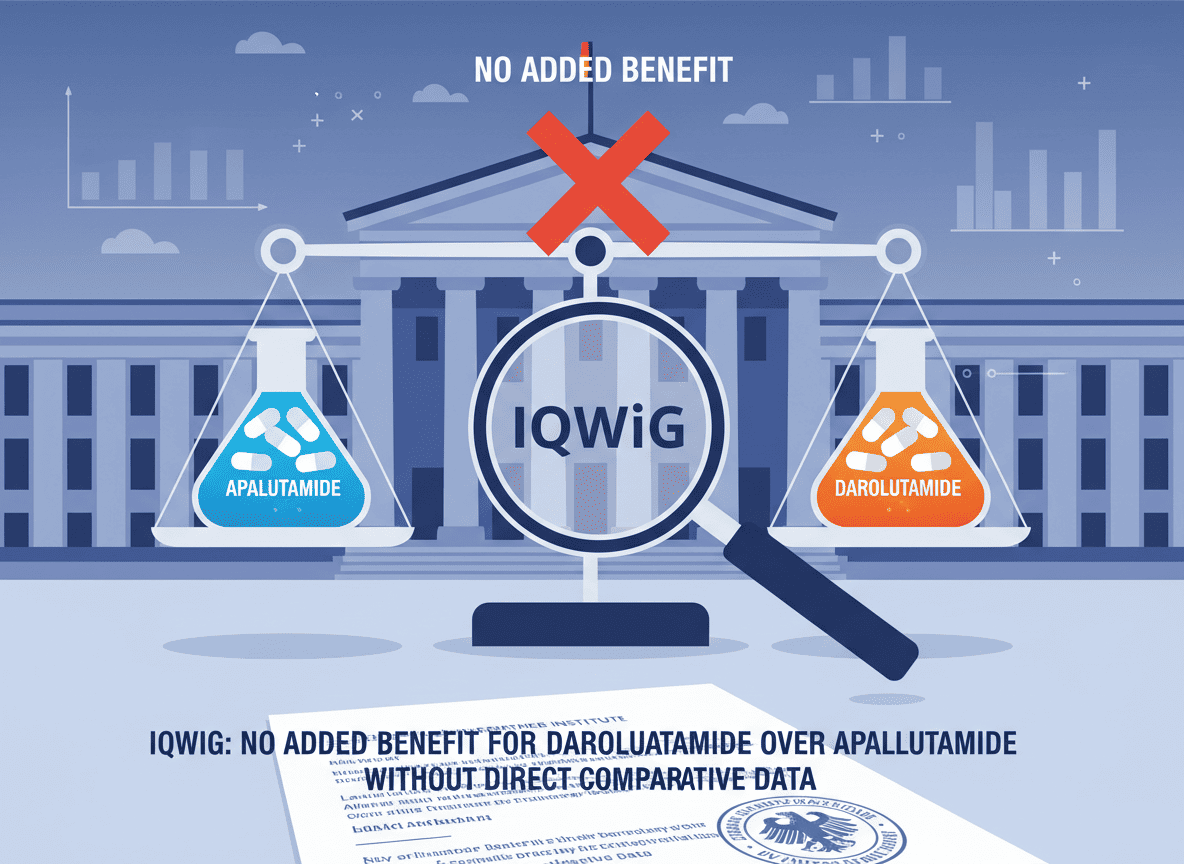
IQWiG Finds No Added Benefit for Darolutamide Over Apalutamide in mHSPC Due to Lack of Direct Comparison
A new benefit assessment from Germany’s Institute for Quality and Efficiency in Health Care (IQWiG) has concluded that darolutamide offers no proven added benefit over apalutamide for patients with metastatic hormone-sensitive prostate cancer (mHSPC). The finding highlights a growing concern in oncology drug development, the continued reliance on indirect comparisons even when established standard therapies are available, leaving critical clinical questions unanswered.
The analysis stems from the European Commission’s July 2025 approval of darolutamide + androgen deprivation therapy (ADT) for mHSPC, expanding its use beyond chemotherapy-dependent settings. With apalutamide long established in clinical practice for the same population, IQWiG sought to determine whether darolutamide brings meaningful advantages. Instead, the agency found the evidence insufficient largely because the manufacturer did not conduct a direct head-to-head study.
What You Need To Know
- IQWiG concluded no added benefit for darolutamide versus apalutamide due to lack of direct comparison.
- Manufacturer relied only on indirect placebo-controlled comparisons, limiting clinical certainty.
- Expert reviewers criticized use of placebo despite established standard therapy.
- G-BA will issue the final benefit rating, shaping reimbursement and market access.
A Missing Comparison at the Heart of the Assessment
According to IQWiG, the manufacturer presented placebo-controlled data for darolutamide and referenced separate placebo-controlled studies for apalutamide. Without a dedicated comparative trial, the agency was forced to rely on an adjusted indirect comparison a method that introduces statistical limitations and cannot replace a direct randomized comparison.
IQWiG’s oncology head, Dr. Volker Vervölgyi, was clear in his critique failing to compare darolutamide directly to apalutamide represents a missed opportunity both scientifically and ethically. “A direct comparative study would have provided significantly more reliable information,” he said. “Furthermore, the patients in the comparison group of the darolutamide study would have been spared the inferior placebo therapy.”
Because the only interpretable data with sufficient accuracy were the overall survival results, the indirect comparison ultimately showed no advantage for darolutamide over apalutamide.
A Rapidly Evolving mHSPC Treatment Landscape
The mHSPC field has transformed significantly in recent years, with multiple androgen receptor inhibitors (ARIs) demonstrating survival improvements. Apalutamide, enzalutamide, and abiraterone have all been established through large, well-controlled studies. For new entrants such as darolutamide, differentiation requires strong comparative evidence, particularly when seeking reimbursement and positioning in competitive European markets.
Darolutamide’s approval without concurrent chemotherapy has clinical value, but without direct data, its comparative effectiveness remains uncertain. Regulators increasingly expect manufacturers to provide head-to-head evidence when standard-of-care options already exist.
IQWiG’s analysis further points out that including a placebo arm in the darolutamide trial despite the availability of apalutamide as standard therapy means some patients received suboptimal treatment. This criticism echoes broader debates over placebo use in oncology trials where active comparators are established.
“Patients could have been spared an inferior placebo therapy,” Vervölgyi emphasized. The comment underscores the need for ethics committees and sponsors to adapt trial designs as treatment standards evolve.
Under Germany’s AMNOG process, IQWiG’s dossier assessment is only the first stage. The Federal Joint Committee (G-BA) will now review the analysis, consult stakeholders, and issue a formal decision on the extent of added benefit or lack thereof.
The G-BA’s determination influences pricing and reimbursement negotiations. Given the absence of superiority evidence, darolutamide may receive a neutral or “no additional benefit” rating, affecting its commercial positioning within Germany’s tightly controlled market.
This assessment reinforces several trends in oncology evaluation:
- Regulators are less willing to accept indirect evidence when direct comparison is feasible.
- Manufacturers introducing new agents into established treatment classes face increasing pressure to differentiate through robust, head-to-head clinical trials.
- Ethical scrutiny of placebo-controlled trials continues to intensify, especially in diseases where effective active therapies exist.
Related news
Hereditary Angioedema Drug From CSL Gains German Backing
While darolutamide remains an approved option for mHSPC, there is no evidence-based reason to prioritize it over apalutamide based on currently available data.
As competition increases across androgen-receptor-targeted therapies, clinical decisions will continue to rely on real-world evidence, safety profiles, accessibility, and patient-specific considerations until more definitive comparative studies are conducted.