
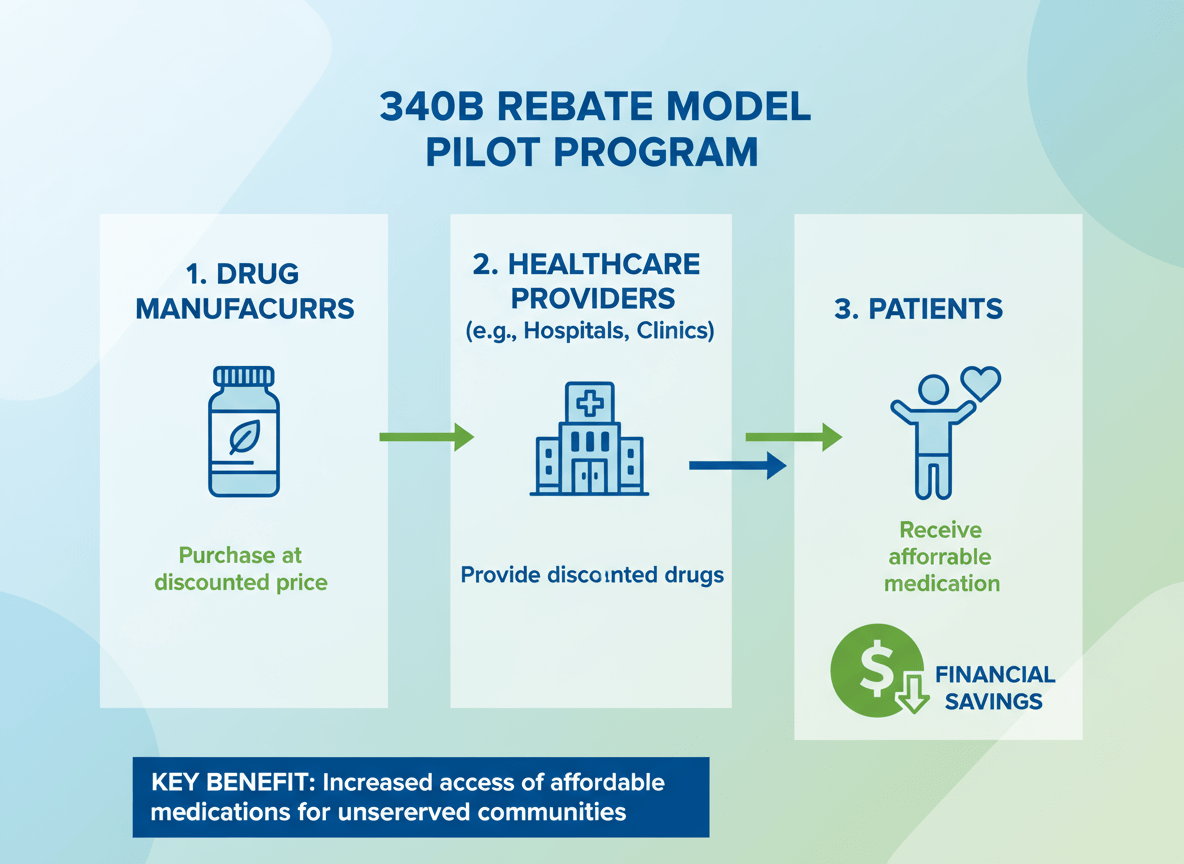
The federal agency that oversees the 340B rebate Drug Pricing Program is moving ahead with a pilot that could reshape how hospitals and drugmakers handle discounts for safety-net care.
The Health Resources and Services Administration (HRSA) confirmed that eight pharmaceutical companies have received approval to participate in the 340B Rebate Model Pilot Program, scheduled to begin January 1. The pilot replaces the long-standing upfront discount system with a rebate-based approach — a technical shift that could have big implications for how hospitals finance care for low-income patients.
Under the 340B Rebate model program, drugmakers are required to sell outpatient drugs to eligible hospitals and clinics at steep discounts. Those savings, in turn, help hospitals stretch budgets and support community care. But in recent years, the program has been fraught with disputes between hospitals, manufacturers, and the federal government over transparency, contract-pharmacy oversight, and data access.
What You Need To Know
- The list of the eight drug-companies and specific drugs approved will be closely monitored; gaps or exclusions could hint at manufacturer strategy or pricing negotiations.
- Data from the pilot’s first year such as cost impact for covered entities, rebate capture rates, and audit findings will determine whether the model scales.
- Hospitals, represented by American Hospital Association (AHA), argue that HRSA underestimated the administrative and financial burdens of the pilot.
- Covered entities must purchase through their 340B wholesaler accounts and maintain auditable records; HRSA will audit both manufacturers and covered entities.
- Hospital responses: whether entities adapt operationally or push back harder if burdens become untenable.
HRSA’s new pilot aims to test whether switching to rebates instead of upfront discounts can modernize the system. In the new setup, hospitals will continue to buy drugs through designated 340B wholesaler accounts, but instead of paying reduced prices, they’ll pay full price and later claim 340B rebates based on eligible dispensed units. HRSA argues the change could make the process more traceable and less vulnerable to data gaps or pricing disputes that have dogged the traditional model.
However, hospital groups see the proposal less as innovation and more as red tape. In a September 30 letter, the American Hospital Association (AHA) urged HRSA to pause the pilot, arguing that the agency “vastly underestimates the financial and administrative costs” of what it calls a complex tracking experiment.
AHA’s main concern: hospitals will now have to manage two data systems one for purchasing and one for rebate reconciliation creating a new layer of audit exposure. Each transaction under the pilot must tie directly to a 340B-eligible patient record, ensuring no duplicate discounts or ineligible claims. “That’s not a light administrative task,” one hospital compliance officer said. “It’s a whole new infrastructure.”
The pilot’s audit requirements are expected to extend to both covered entities and manufacturers. HRSA has made clear it intends to monitor how rebates are calculated and paid, aiming to identify “the merits and shortcomings” of a rebate-based approach. The agency has not disclosed which eight drugmakers have been approved, though industry analysts expect participation from companies that have previously restricted 340B pricing to contract pharmacies.
For hospitals, the question is whether the new system will actually preserve savings that the 340B rebate program was designed to deliver. “Rebates introduce time lag and cash-flow uncertainty,” said one AHA policy expert. “Hospitals depend on immediate price reductions to support uncompensated care rebates months later don’t help with payroll next week.”
Drug manufacturers, meanwhile, have been largely supportive of testing alternatives. Many have argued that the current 340B rebate structure lacks accountability and allows discounts to be diverted away from patient benefit. By moving to a rebate model, they believe HRSA can better ensure discounts correspond directly to eligible use and prevent duplicate discounts between Medicaid and 340B.
Still, the shift is delicate. Hospitals fear that changing payment timing could erode their ability to sustain community health programs, especially in rural and underserved regions. Many safety-net hospitals rely heavily on 340B savings to fund oncology, HIV, and pharmacy-assistance services. Even minor delays in reimbursement can strain cash flow.
Related news
Reimbursement Series: CMS and Europe Reimbursement Pathway Accelerates Innovation
Policy observers see the pilot as a small but significant step in HRSA’s long-running effort to modernize 340B oversight. The rebate model could bring greater transparency to the program or it could further complicate an already tangled framework. Much will depend on how efficiently HRSA can manage rebate payments, audits, and data exchange.
For now, hospitals are preparing for what they describe as a costly experiment. “We understand the intent,” said one hospital CFO. “But it’s hard to see how this helps us deliver more care. It looks like a pilot that adds burden first and maybe offers benefits later.”
The 340B Rebate Model Pilot officially begins January 1, with HRSA expected to collect and publish early performance data by mid-2026. Until then, both hospitals and manufacturers will be watching closely not to predict outcomes, but to determine whether this experiment ends up redefining one of healthcare’s most contentious drug-pricing programs.